Fraunhofer ISE (ISE, Germany)
Project lead and coordinator
Fraunhofer ISE (ISE, Germany)
Plug-and-Play, Ultra-silent, Low-footprint and Sustainable heating for European Buildings
The CETP project PULSE (“Plug-and-Play, Ultra-silent, Low-footprint and Sustainable heating for European Buildings”) aims to develop a compact and sustainable heat-pump solution for renovating European multi-family buildings. The 36-month project is coordinated by Fraunhofer ISE. It addresses the widespread dependence on gas- and oil-fired heating systems: much of Europe’s building stock was constructed before 2001, and replacing old boilers is critical to avoiding further investment in fossil-fuel technologies. Existing heat pumps are often too large, expensive, noisy, or difficult to integrate into domestic hot water systems and electricity grids during retrofitting.
At the heart of the project is the Apartment Heating Device (AHD), a wall-mounted heat pump with local domestic hot water storage, designed to replace a gas boiler within each apartment. A central low-temperature heat-source collector and distributor supplies the individual devices through connector lines. Possible heat sources include geothermal energy, urban waste heat—for example from data centres—future fifth-generation low-temperature district heating networks, and, potentially, air in an indirect system. The AHD raises temperatures on demand for space heating and domestic hot water up to 75 °C. Local hot water production reduces the need for long circulation pipes, lowers heat losses, and is expected to reduce the risk of Legionella compared with central storage systems.
PULSE combines expertise from the heating, refrigeration, and automotive industries. Its main innovations include a lightweight compressor made predominantly from aluminium, a compact aluminium heat-exchanger thermomodule, and designs optimised to minimise vibration and noise. The system is intended to use the climate-friendly natural refrigerant propane (R290), with a refrigerant charge of no more than 150 g.
The “circular-by-design” approach focuses on reducing material use, improving recyclability, and using up to 70% recycled aluminium. Key targets include a heating capacity of 10 kW, a reduction in device weight, a compact unit with a storage volume below 80 litres, sound emissions of no more than 40 dBA, and seasonal performance coefficients between 5 and 7.2. Compared with current solutions, life-cycle costs could be reduced by up to 30%, while greenhouse-gas emissions could fall by around 75% compared with gas heating.
The project is organised into seven work packages. First, it gathers regulatory requirements, technical performance indicators, and the needs of residents, housing associations, facility managers, and installation companies. Based on these findings, two successive prototypes will be developed: an Alpha prototype using readily available components to test basic functionality, followed by a Beta prototype incorporating the newly developed components and stakeholder-driven features. Testing will cover thermal performance, operation under realistic hardware-in-the-loop conditions, acoustics and vibrations, corrosion resistance, leak tightness, and long-term reliability.
In parallel, PULSE develops intelligent control strategies at device, building, and grid level. These controls will consider photovoltaic electricity, thermal storage, user behaviour, building thermal inertia, and grid signals. Their purpose is to reduce peak loads and enable heat pumps to act as flexible resources in future smart grids.
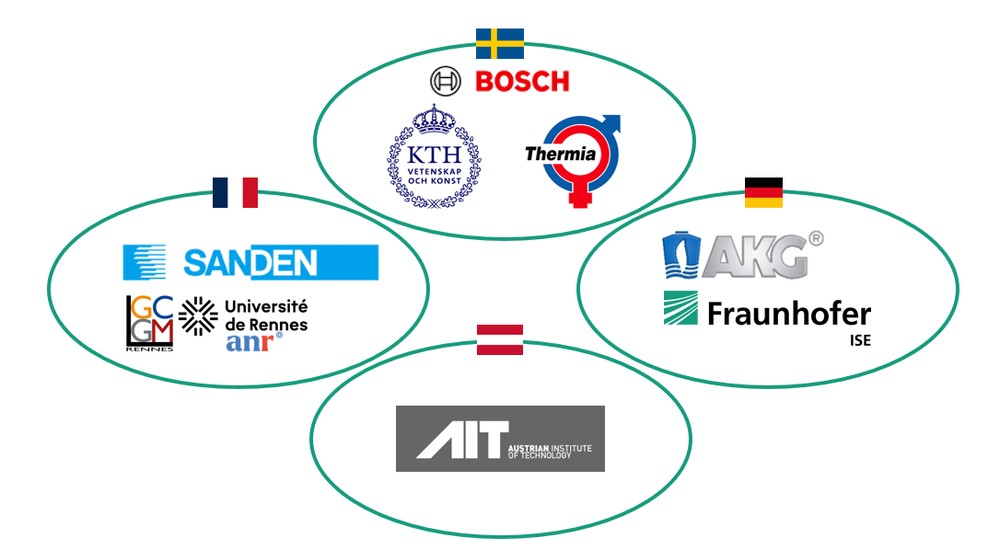
Life-cycle assessments and life-cycle cost analyses will evaluate environmental and economic performance from manufacturing through recycling. The project also addresses standardisation and certification. The consortium brings together research institutions, component suppliers, and heat-pump manufacturers from Germany, Sweden, Austria, and France, supported by a stakeholder panel. Overall, PULSE seeks to create a quiet, easy-to-install, and scalable European alternative to fossil-fuel boilers and central high-temperature heating systems.